
The 1943 Mercury dime is common in most grades. Millions were struck during World War II. Circulated examples trade close to the silver value. Even Mint State coins are available.
Yet collectors pay strong premiums for pieces labeled “Full Bands.” The difference can be noticeable, especially in higher grades.
What does Full Bands actually mean? And how rare is a truly sharp 1943 strike?
Characteristics of the 1943 Mercury Dime
The 1943 issue has the same minting standards as other coins in the Mercury dime series.
Parameter | Specification |
Year | 1943 |
Series | Winged Liberty Head |
Composition | 90% Silver, 10% Copper |
Weight | 2.50 grams |
Silver Content | 0.0723 troy oz |
Diameter | 17.9 mm |
Edge | Reeded |
Designer | Adolph A. Weinman |
Mints | Philadelphia (no mark), Denver (D), San Francisco (S) |
Nothing unusual changed in 1943. The alloy remained 90% silver. The design stayed the same. The coin was struck at three mints.
What separates one piece from another is not the metal content. It is the sharpness of the strike.
What Does “Full Bands” Mean?
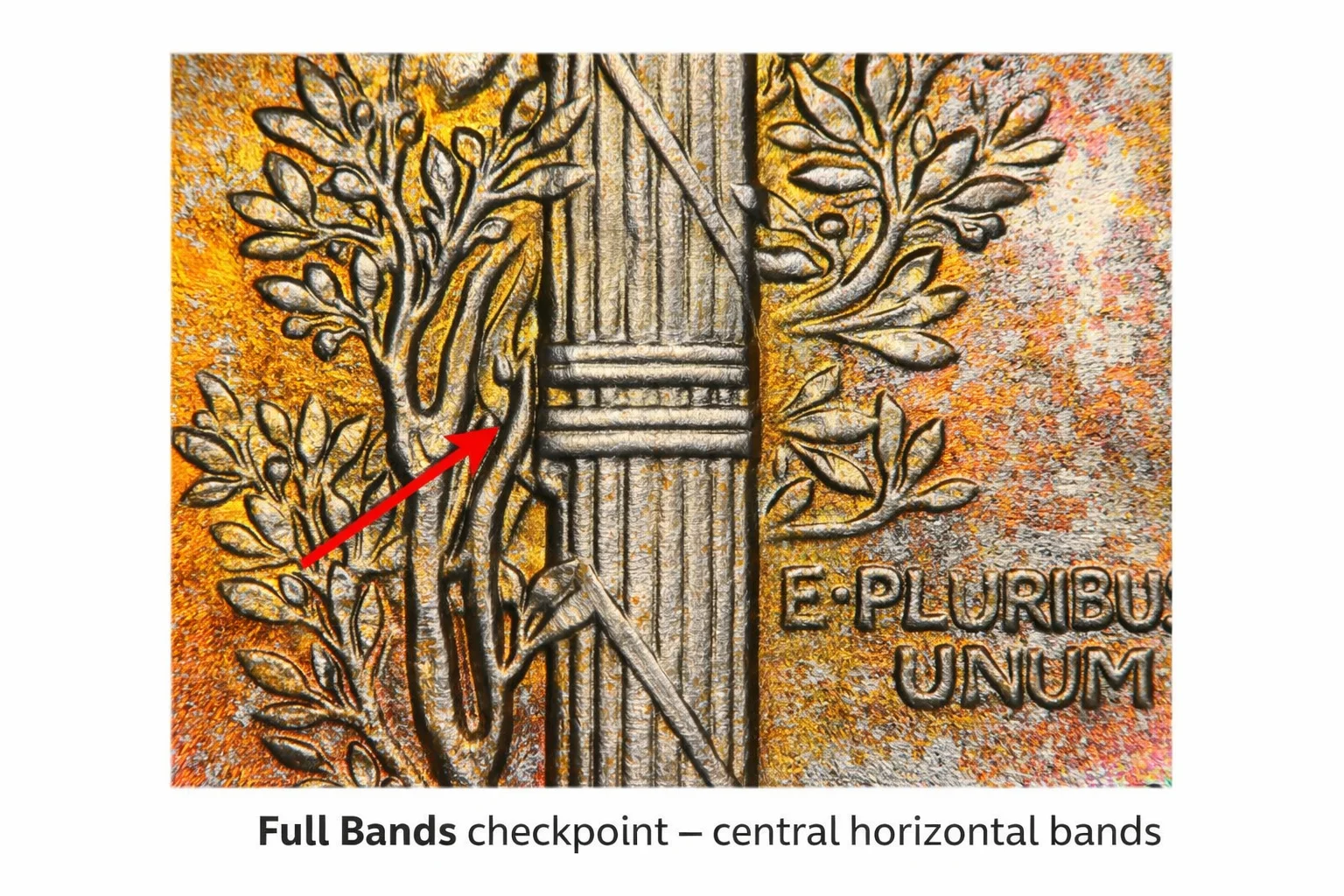
On the reverse of the Mercury dime is a fasces. It consists of bundled rods tied by horizontal bands. In the center of that fasces are two distinct horizontal bands.
Full Bands (often abbreviated FB) refers to the complete separation of those central bands. The lines must be clear. They must not blend together. The separation must be visible across the entire width.
This designation does not measure wear. It measures strike quality.
A coin can grade MS66 and still lack Full Bands. Another coin can grade MS65 and qualify for FB. The grade reflects surface preservation. The FB label reflects strike sharpness.
That distinction is critical.
Why the Bands Are So Important
The central bands sit in a high-relief area. During striking, metal must flow evenly into that region. If the pressure is slightly weak or the die is worn, the bands lose definition.
The bands act as a test point. If they are sharp, the strike was strong. If they are weak, the strike was average or soft.
Other details may still appear solid. Liberty’s portrait might look clean. The torch flame might appear defined. Yet the central bands often show weakness first.
That is why collectors focus on them.
The bands reveal how well the coin was struck.
Wartime Production and Quality of Coins
The year 1943 sits in the middle of World War II. Mint facilities operated at high output. Equipment ran continuously. Die replacement cycles were frequent.
High production affects consistency.
When dies wear quickly, fine details soften. The central bands are among the first to show that softness.
Wartime conditions did not change the silver alloy. They did not change the design. However, large output increases the likelihood of slight strike variation.
Common observations on 1943 dimes include:
Slight weakness at the center of the fasces
Mild blending of horizontal bands
Soft detail in the middle reverse
This does not mean sharp examples do not exist. They do. It means fully separated bands are less common than average strikes.
Strike quality is not random. It reflects the state and press pressure at the moment of production.
Mintage and Strike Distribution
The 1943 Mercury dime was struck in large numbers:
Mint | Estimated numbers |
1943 (P) | ~191,710,000 |
1943-D | ~71,949,000 |
1943-S | ~60,400,000 |
These are substantial totals. By mintage alone, the year is common.
However, mintage does not measure strike sharpness. A large portion of coins were struck from worn dies. Many were handled heavily in circulation.
Full Bands survival depends on two things:
A strong original strike
Preservation without heavy wear
Even a coin that left the Mint with sharp bands can lose separation if lightly worn.
Strike and survival work together.
How Rare Is 1943 in Full Bands?
Full Bands examples exist for all three mints. They are not impossible to find. However, their availability changes with grade.
In lower Mint State levels, such as MS63 or MS64, Full Bands pieces are obtainable. The premium over non-FB examples is moderate.
In MS65, separation becomes more meaningful. Many coins at this level show slight band weakness. Clear separation reduces the pool.
In MS66 and especially MS67, the situation changes. The number of coins that combine:
Strong strike
Clean surfaces
Minimal contact marks
Full band separation
is much smaller.
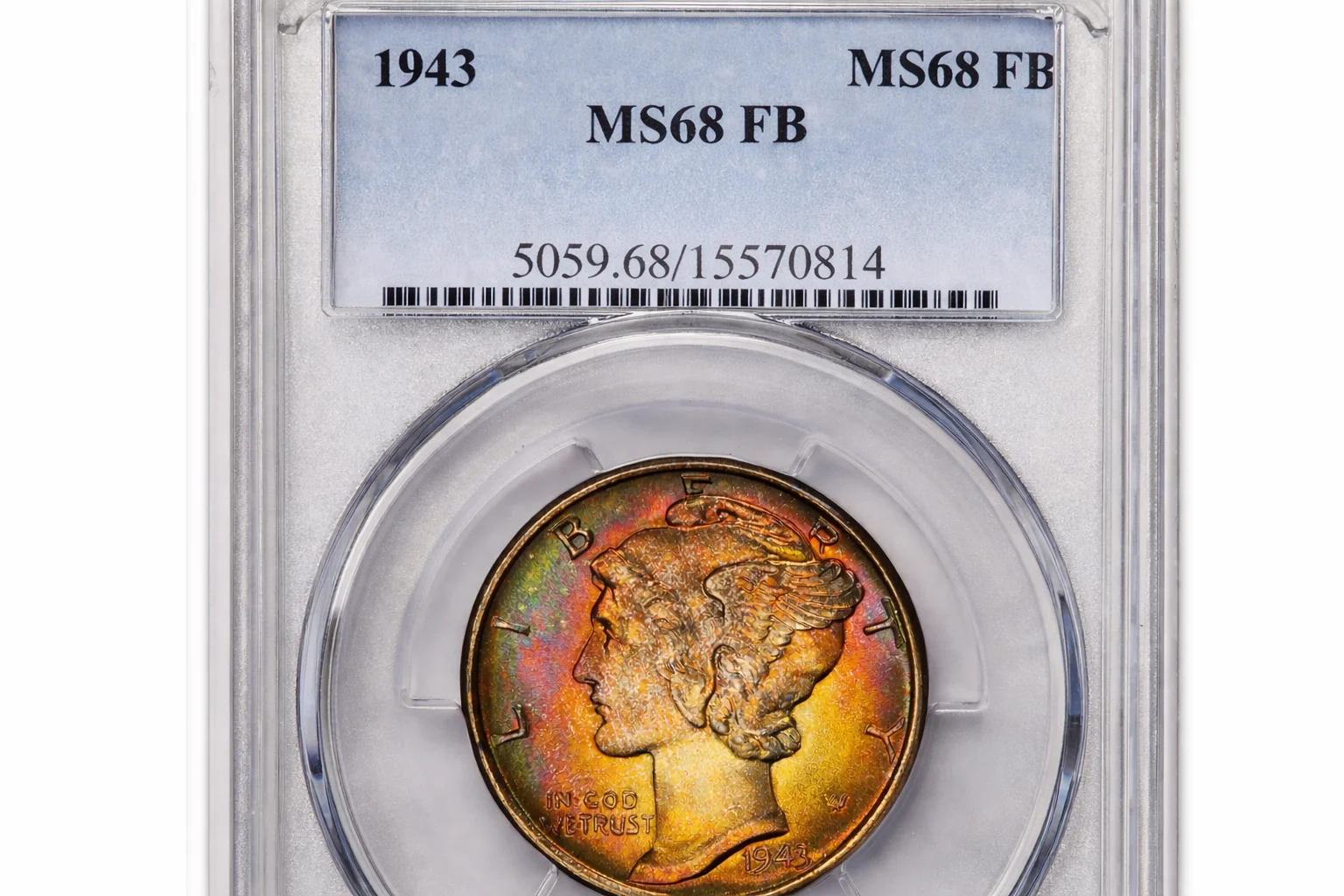
At the top, such as MS67 FB, scarcity increases sharply. MS68 FB examples are extremely rare and seldom appear.
Full Bands become more important as the grade rises.
Strike vs Grade: Two Different Measures
Collectors often confuse strike quality with condition.
Grade evaluates:
Surface marks
Wear
Luster
Eye appeal
Full Bands evaluates:
Sharpness of the central horizontal bands
A coin may show few contact marks and strong luster but lack band separation. That coin can grade high but not earn FB.
Another coin may have slightly more contact marks yet display crisp band detail. It may earn FB at a slightly lower numeric grade.
Which is better depends on the buyer’s focus.
In many cases, collectors prefer a slightly lower grade with Full Bands over a higher grade without it.
Strike sharpness carries weight.
Common Mistakes When Evaluating Full Bands
Band evaluation requires careful inspection.
Common errors include:
Mistaking the die polish lines for separation
Seeing shadow lines under strong lighting
Confusing light wear with weak strike
Assuming partial separation qualifies as full
For a coin to qualify, the bands must show clear, uninterrupted separation. The lines should not fade in the center. They must not blend at the edges.
Magnification helps. Neutral lighting helps. Rotating the coin under a steady light source reveals whether the separation is real.
Partial lines do not count.
Market Premium: When Does FB Matter Most?
In circulated grades, Full Bands rarely carry strong premiums. Wear removes sharpness.
In lower Mint State grades, the premium exists but remains moderate.
In MS65, the difference becomes noticeable. Collectors building higher-end sets start paying attention.
In MS66 and above, the premium grows. At MS67, Full Bands can significantly separate prices between otherwise similar coins.
The reason is simple. The number of coins meeting both criteria ( high grade and strong strike) is limited.
Registry competition amplifies that effect. Collectors seeking top-ranked sets focus on FB examples. That demand pushes prices upward.
Full Bands does not always multiply value. But at upper levels, it often defines the ceiling.
Understanding True Scarcity
The 1943 Mercury dime is not rare. Millions survive. Many are attractive.
However, truly sharp strikes are less common than total mintage suggests.
A strong strike requires:
Proper die alignment
Adequate pressure
Fresh dies
Minimal wear
Then the coin must survive decades without friction that blends those delicate lines.
That combination narrows the field.
Scarcity at the top is not about how many were made. It is about how many remain sharply defined.
Practical Evaluation Strategy
When you are trying to examine an FB on a 1943 Mercury dime, follow these steps:
Confirm the main parameters, year, and mint mark. If you are not sure, try the Coin ID Scanner app. It offers a detailed coin card and even an estimated market value.
Inspect the central fascia area under magnification.
Check for full separation across both horizontal bands.
Ensure no wear bridges the lines.
Evaluate overall luster and surface quality.
Avoid relying on photographs alone. Lighting can exaggerate or hide separation.
Certified coins from major grading services clearly note FB status. For raw coins, careful inspection and even consulting a professional are essential.
Conclusion
The 1943 Mercury dime remains a common silver coin by production numbers. It is accessible in most grades. Its melt value sets a floor. Full Bands changes the conversation.
The designation highlights strong strike quality. In higher grades, it becomes scarce. In top Mint State, it defines elite examples.
The difference between an average strike and a sharply struck coin may look small at first glance. In the market, that difference matters.
For collectors who value precision and detail, Full Bands represents more than a label. It reflects the moment when metal flowed perfectly into the die. That moment did not happen on every 1943 dime.